A Handier TFT Analytics Site: Read the Meta, Pick the Right Comps, Plan Your Items — All in One Click
My teammates and I built a data-driven platform designed to deliver one-click conclusions — making it easy to read the TFT meta, choose the right comps, and build the right items. Here's an overview of its key features and core tools.
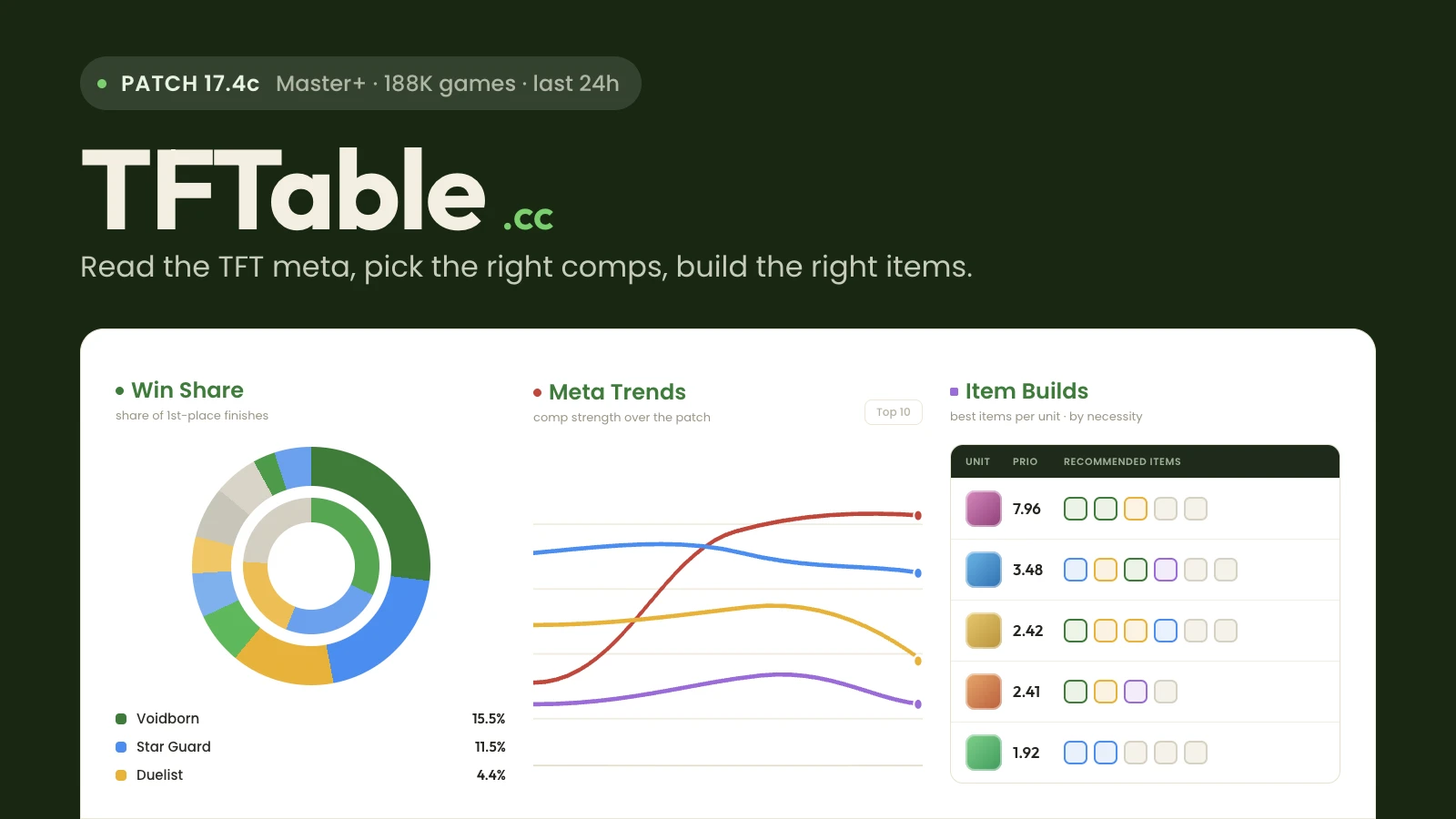
Traditional data sites are like massive data archives. To extract insights for gameplay, you often have to manually set up complex filters, wade through oceans of raw data, and work around one statistical bias after another before getting a result you can trust. To solve this, my teammates and I built a data-driven platform designed to deliver one-click conclusions, making it easy to read the TFT meta, choose the right comps, and build the right items. We're sharing it with everyone because we believe it can help both casual and pro Teamfight Tactics players.
Our site is called TFTable. Most of the content is presented as clear, interactive tables (and charts) — so you're more "able" at TFT by reading the "table".
Below is an overview of our website's key features and core tools:
Meta Read
Win Share
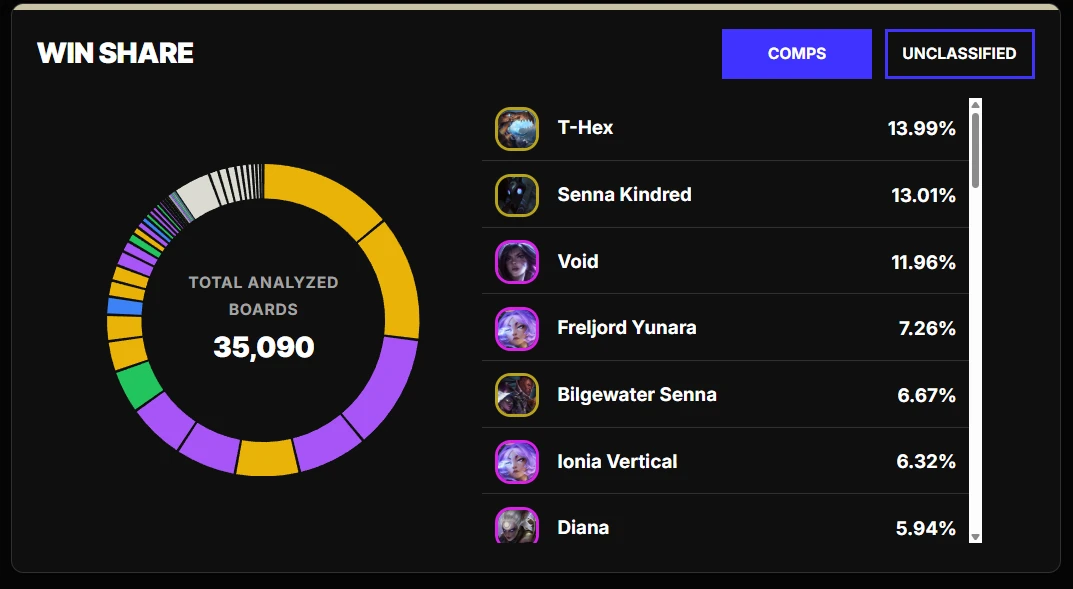
If, out of 10,000 TFT games, 1,399 were taken by a T-Hex comp, then the T-Hex comp would have a win share of 13.99%.
As shown in the chart, we list the strongest comps from highest to lowest win share. The alternating purple and orange slices at the front of the pie chart clearly show that the current meta is dominated by fast 8 boards and legendaries carry comps.
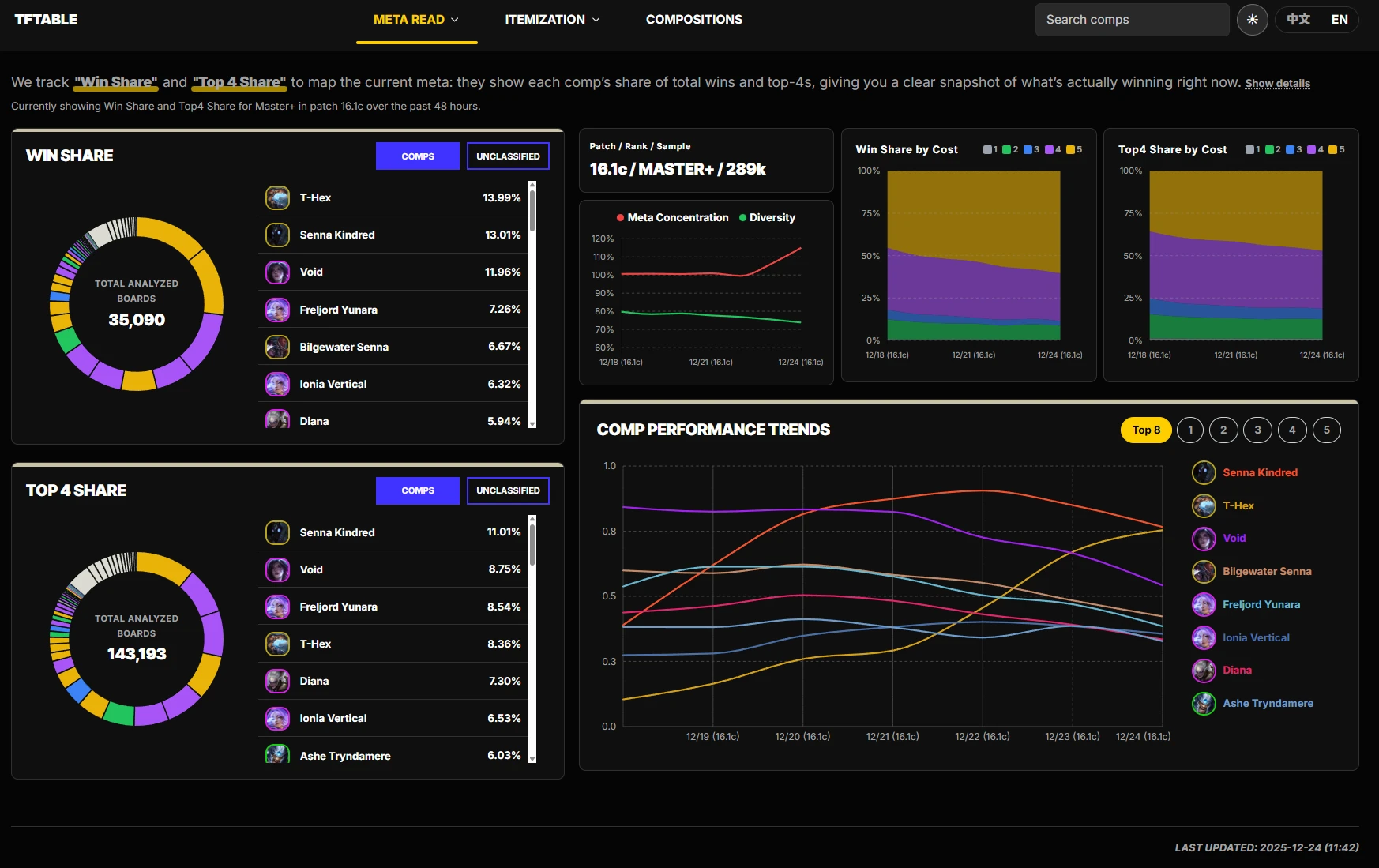
Why Win Share and Top-4 Share are Better Measure of Comp Strength Than Average Placement?
In every patch, several top-tier comps tend to be heavily contested.
Suppose the strongest comp in a patch appears three players chosen in the same lobby, finishing 1st, 4th, and 8th. Its average placement would only be 4.33, which might rank below a low-play-rate comp on a traditional stats site.
You might recall from last set — the "Crystal Gambit" comp was incredibly powerful, often dominating lobbies and taking first place even when five or six players ran it in the same game. Yet its average placement on data sites was roughly 4.7, which clearly didn't reflect how strong it really was.
If we look instead at win share (or top-4 share) data, it becomes obvious that Crystal Gambit was the undisputed top-performing comp of that meta — perfectly matching what players actually experienced in game.
Comp Performance Trend
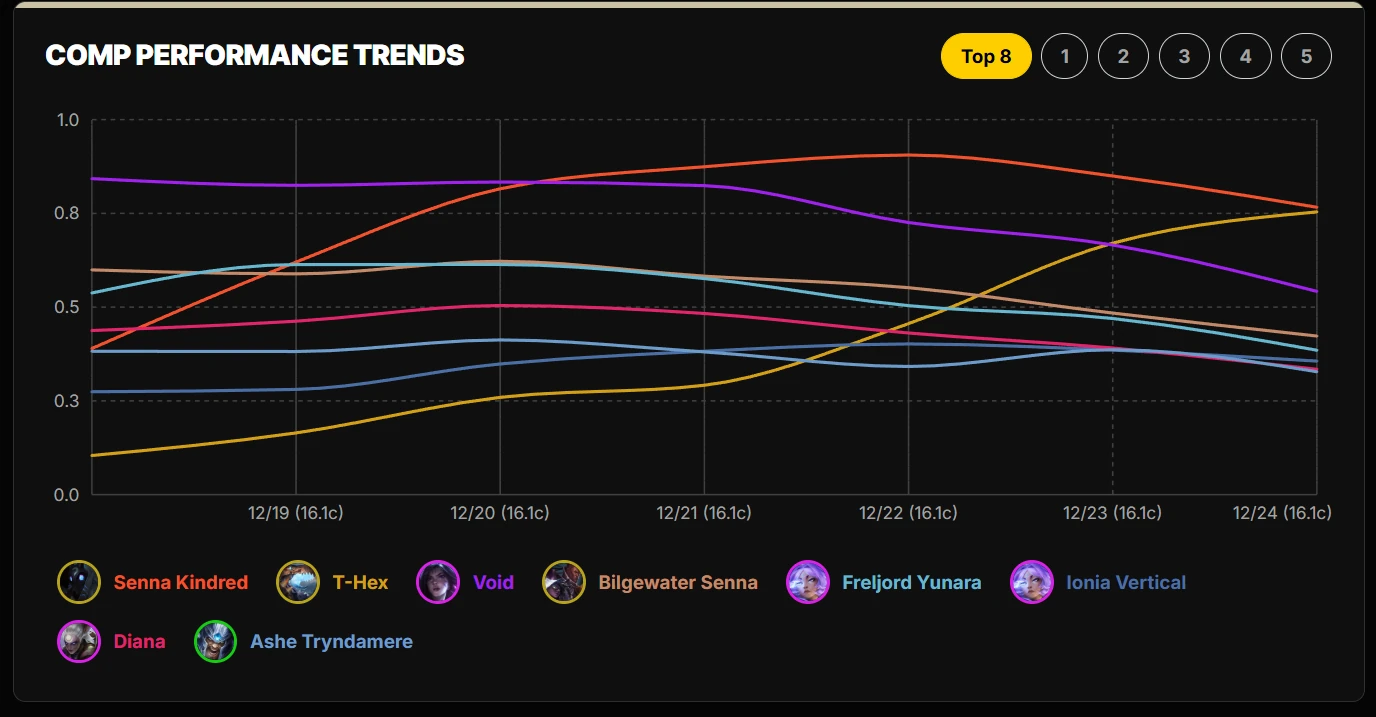
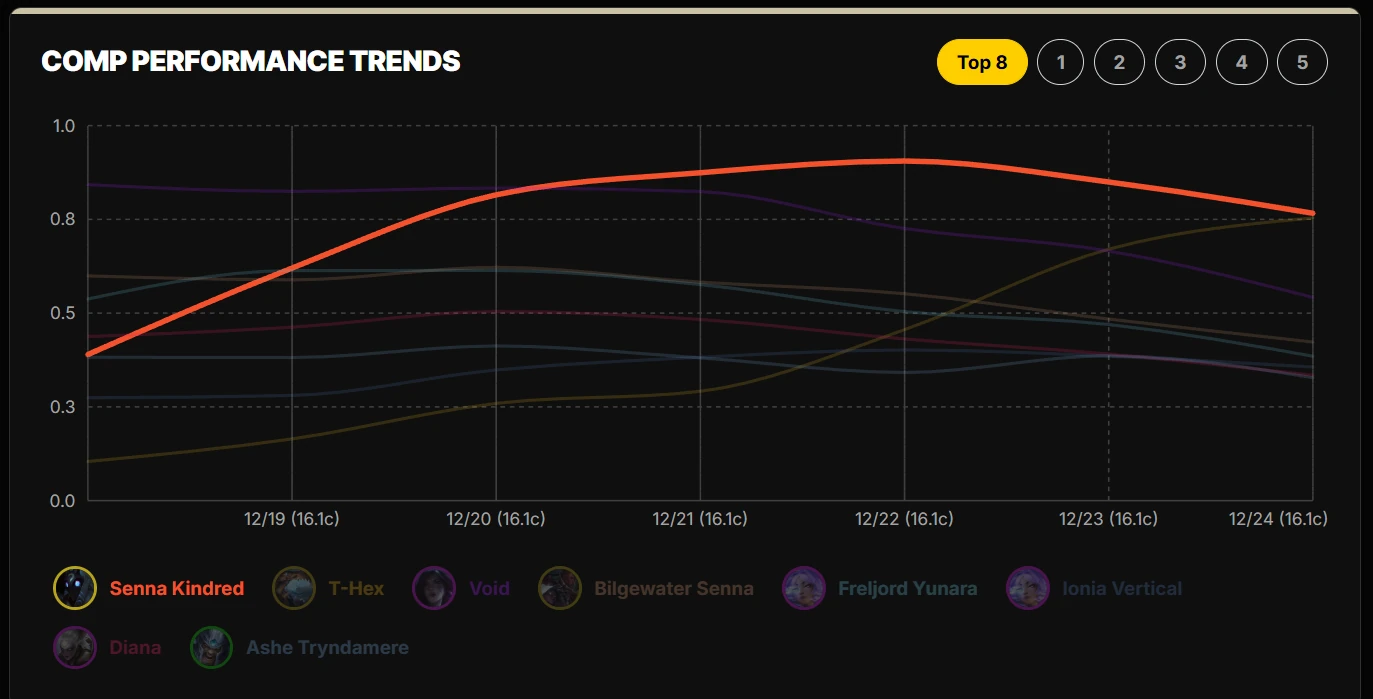
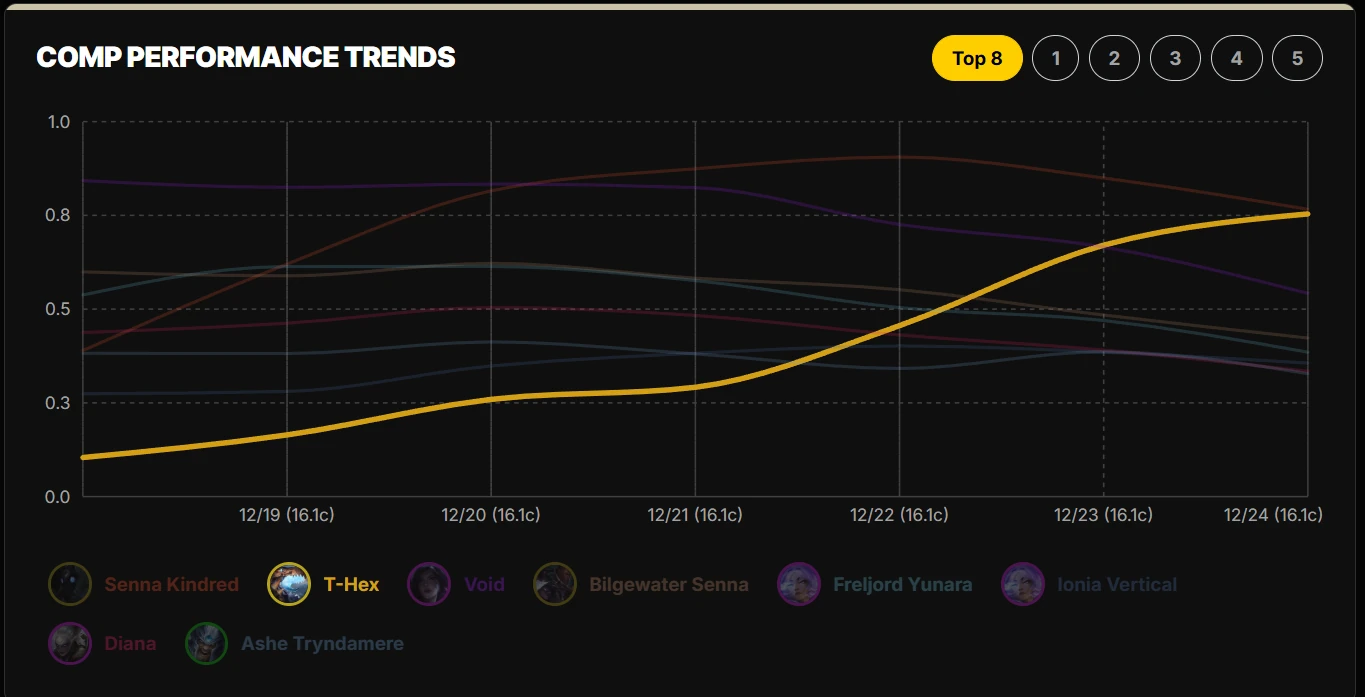
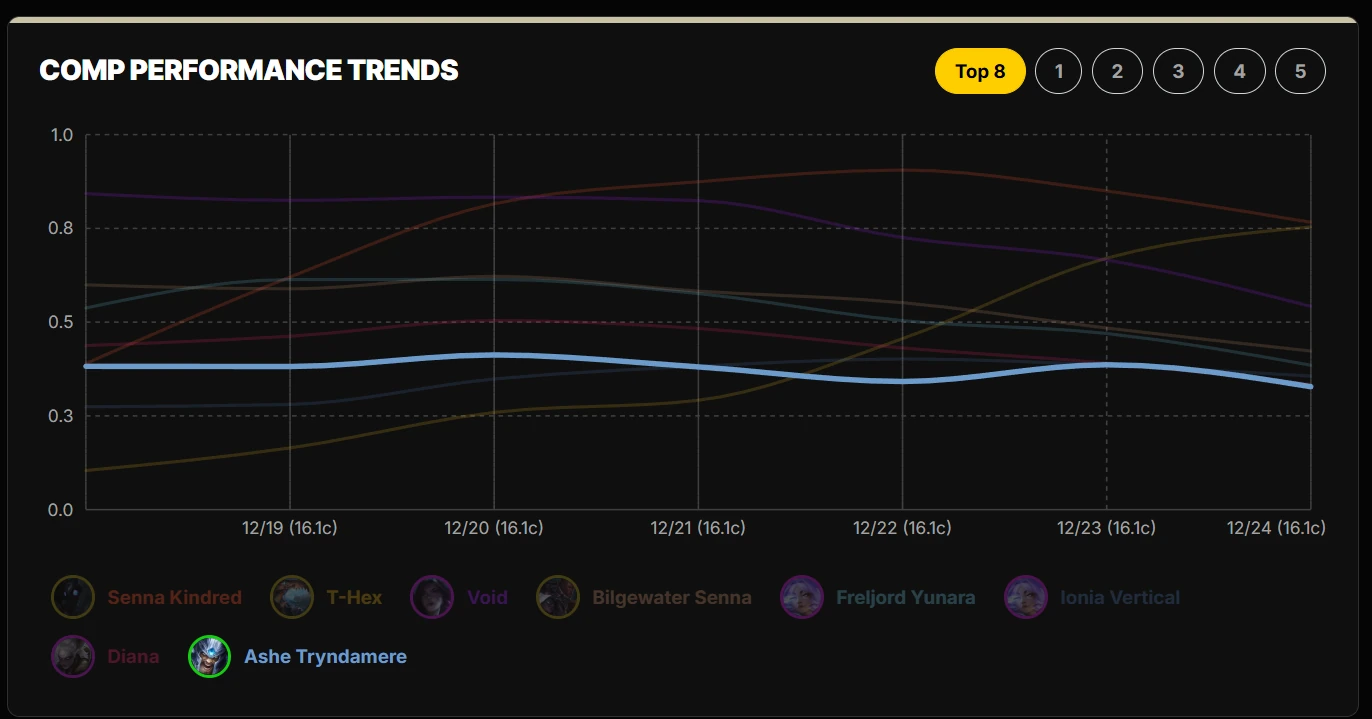
In Comp Performance Trend chart, each comp's overall strength is ranked by an algorithm that factors in average placement, win share, and top-4 share.
As shown in the chart, Senna-Kindred's power peaked around December 22 after steadily climbing throughout the week, but has slightly declined since then, while T-Hex has continued to rise and is now closing the gap. Meanwhile, T-Hex has rapidly emerged as new contenders, reaching nearly the same performance level as Senna–Kindred. As Annie and Mel comps declined in strength and Void units were nerfed, T-Hex became a major threat to backline carries.
Finally, Ashe–Tryndamere has remained one of the most stable reroll comps in the current meta — and if you've been following our website, you would have caught this comp's rise early, right when the meta shifted.
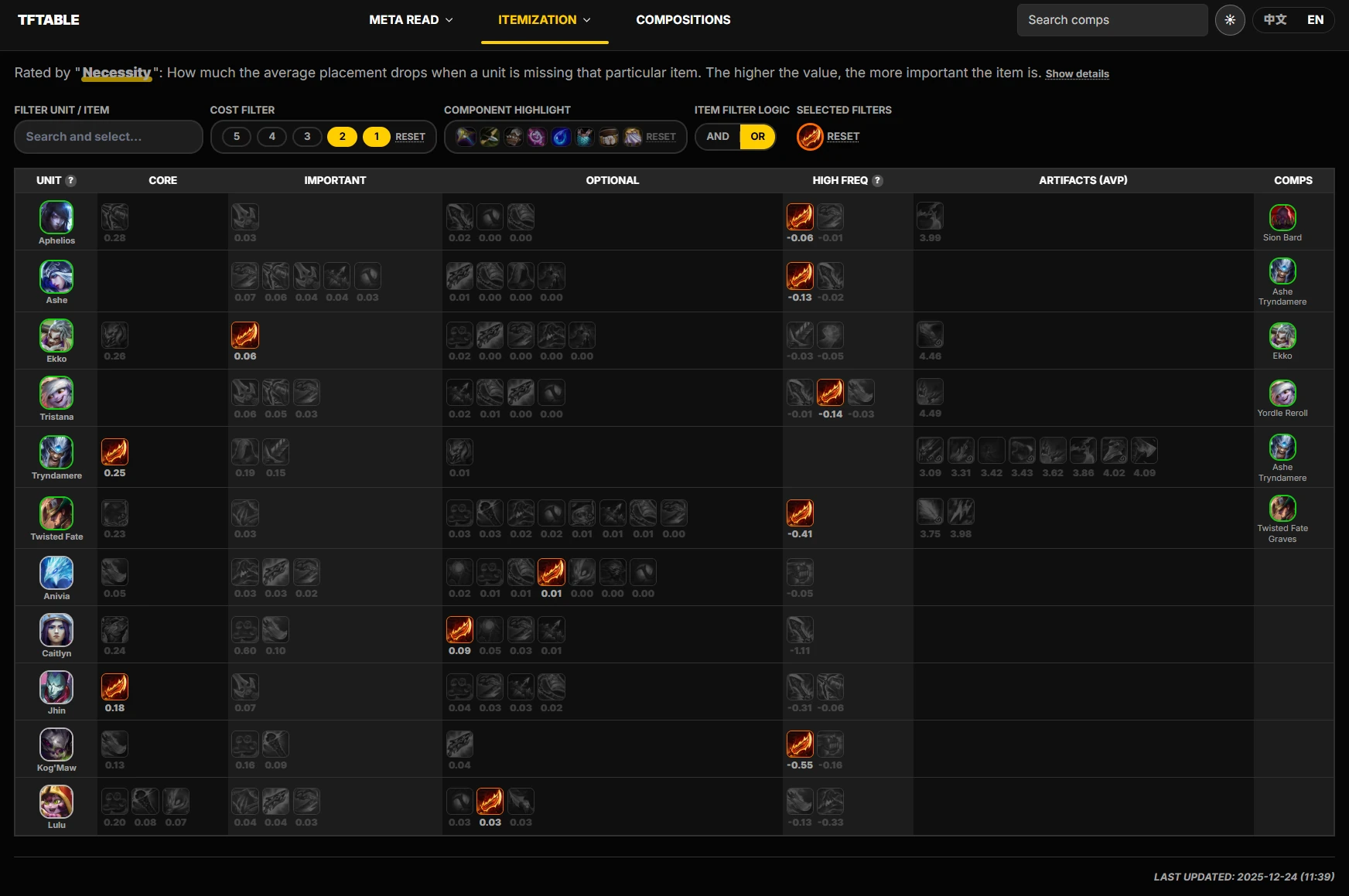
Itemization
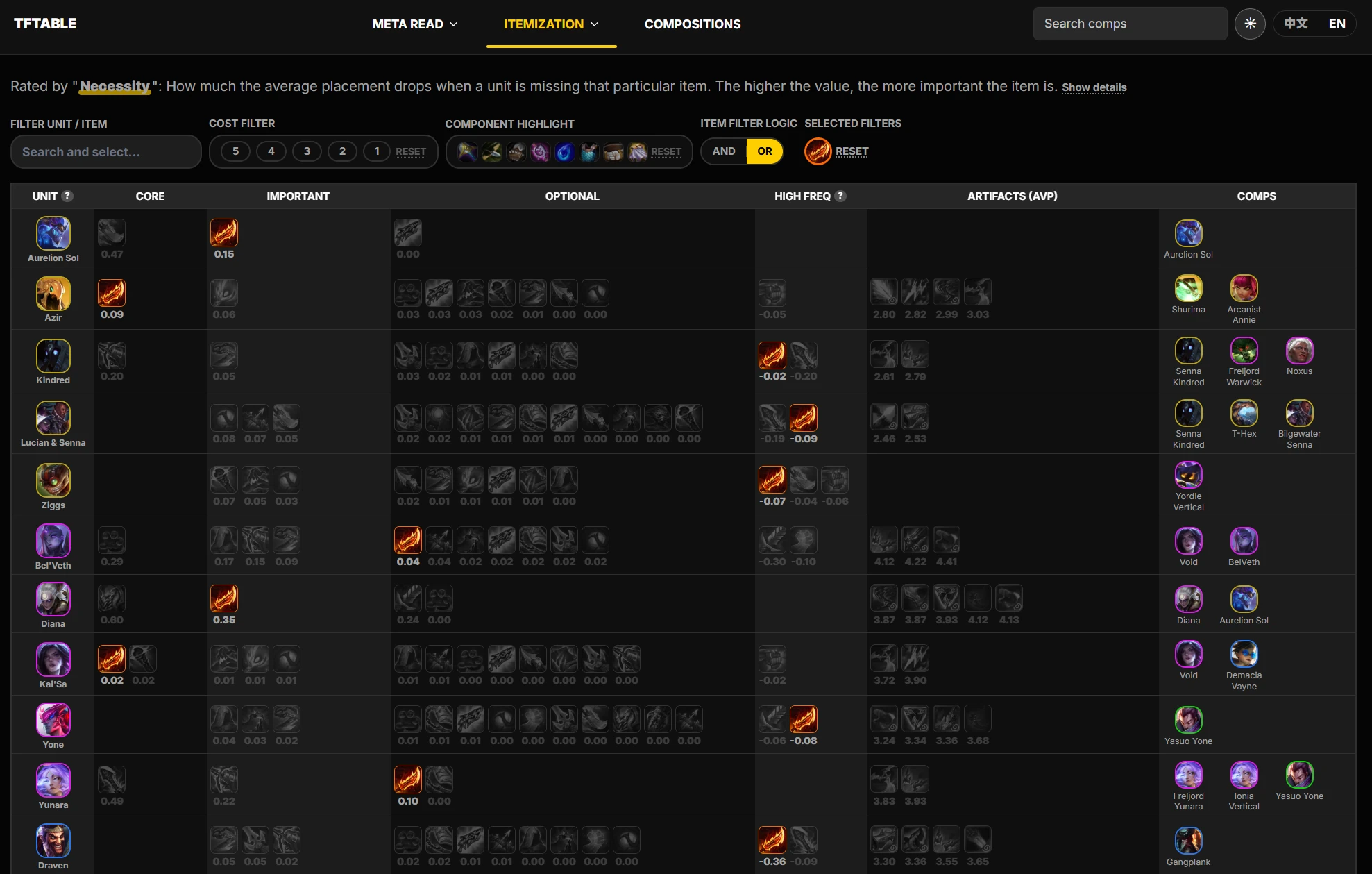
For each unit, we standardize the scenario by fixing the star level and three equipped items, then derive a single-chart view of the optimal item build under those assumptions.
You can also click on any individual craftable item to view its full transition path from low-cost to high-cost carries.
For example, selecting Guinsoo's Rageblade shows that Jhin is one of the strongest early-game item holders for it, allowing you to smoothly transition the item into endgame carries such as Tryndamere reroll, Void Kai'Sa, or Azir.
This feature helps players adapt quickly to new sets and make clearer item transition decisions — showing when an item should stay on a temporary item holder and when it's time to move it onto a real carry unit.
Compositions
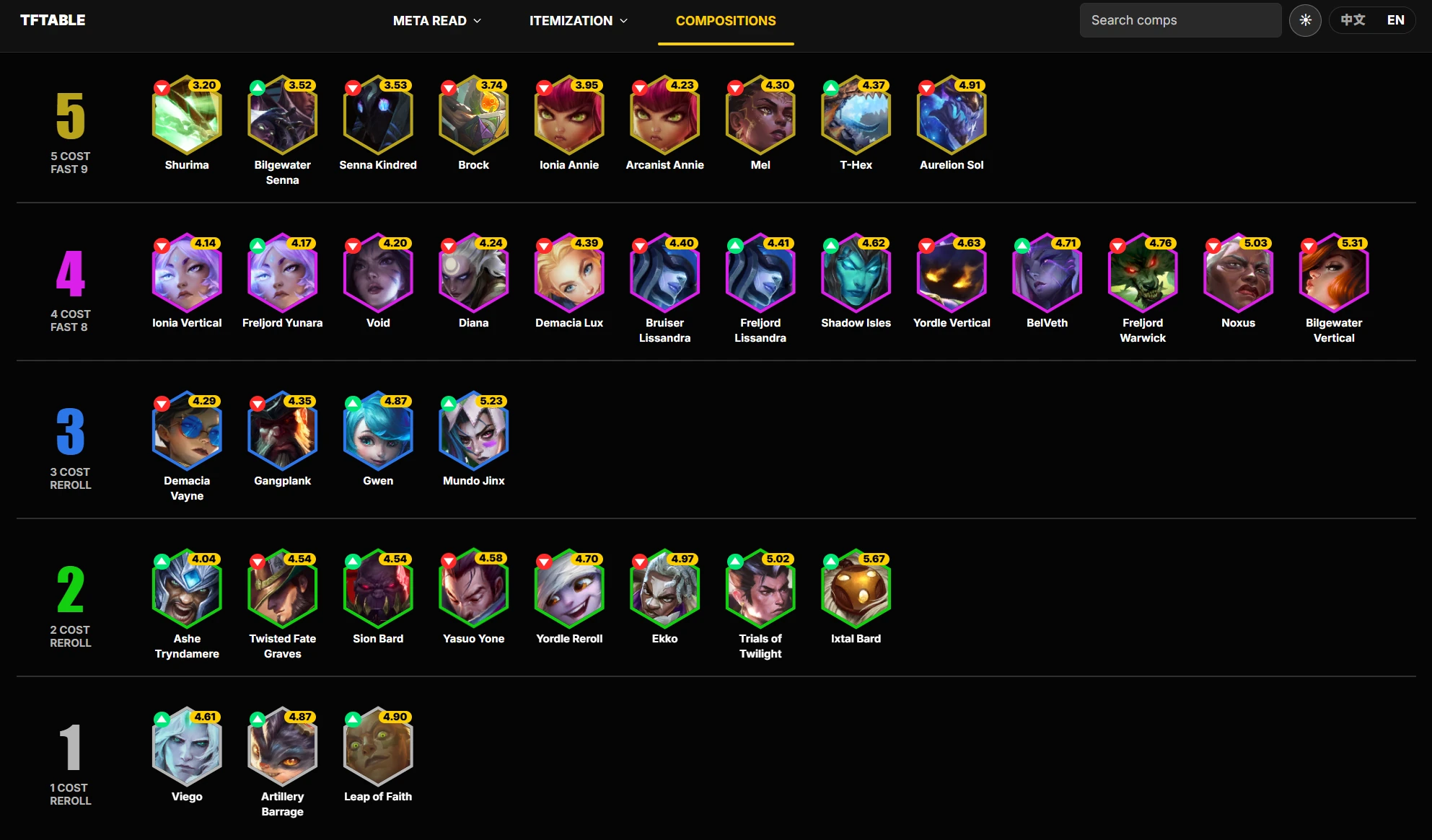
We include around 95% of the viable comps in the current patch, categorized by cost tiers to make them easy to use in-game. This allows players to quickly look up the composition, unit setup, variants, and itemization for whatever comp they're currently playing.
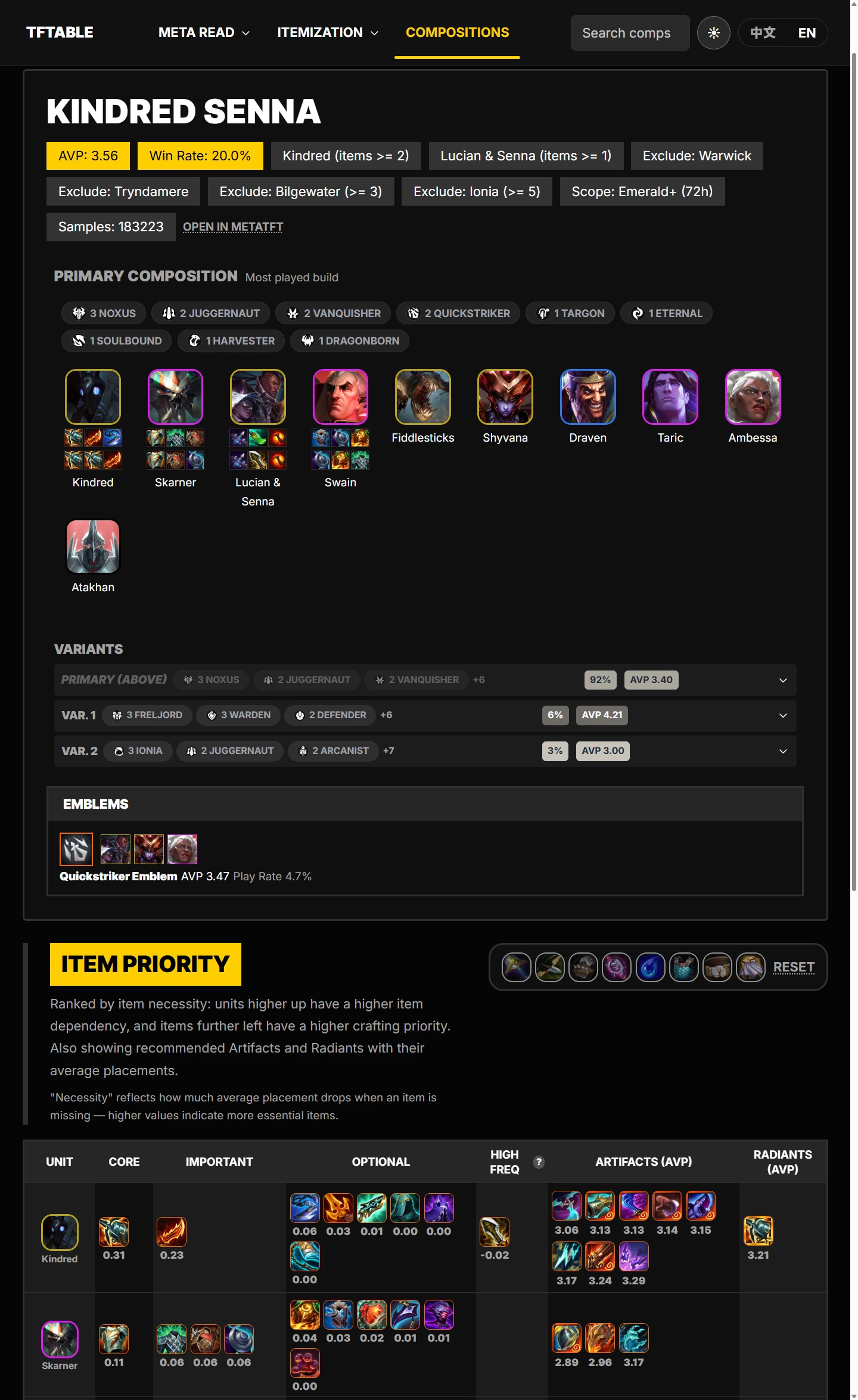
For example, opening the Senna–Kindred comp shows the most common build: a Senna–Kindred flex board. Units are displayed in item priority order, meaning the leftmost unit (Kindred) should be prioritized first when assigning items. Her two best core builds are Guinsoo's Rageblade + Kraken Slayer + Giant Slayer or Guinsoo's Rageblade + double Kraken.
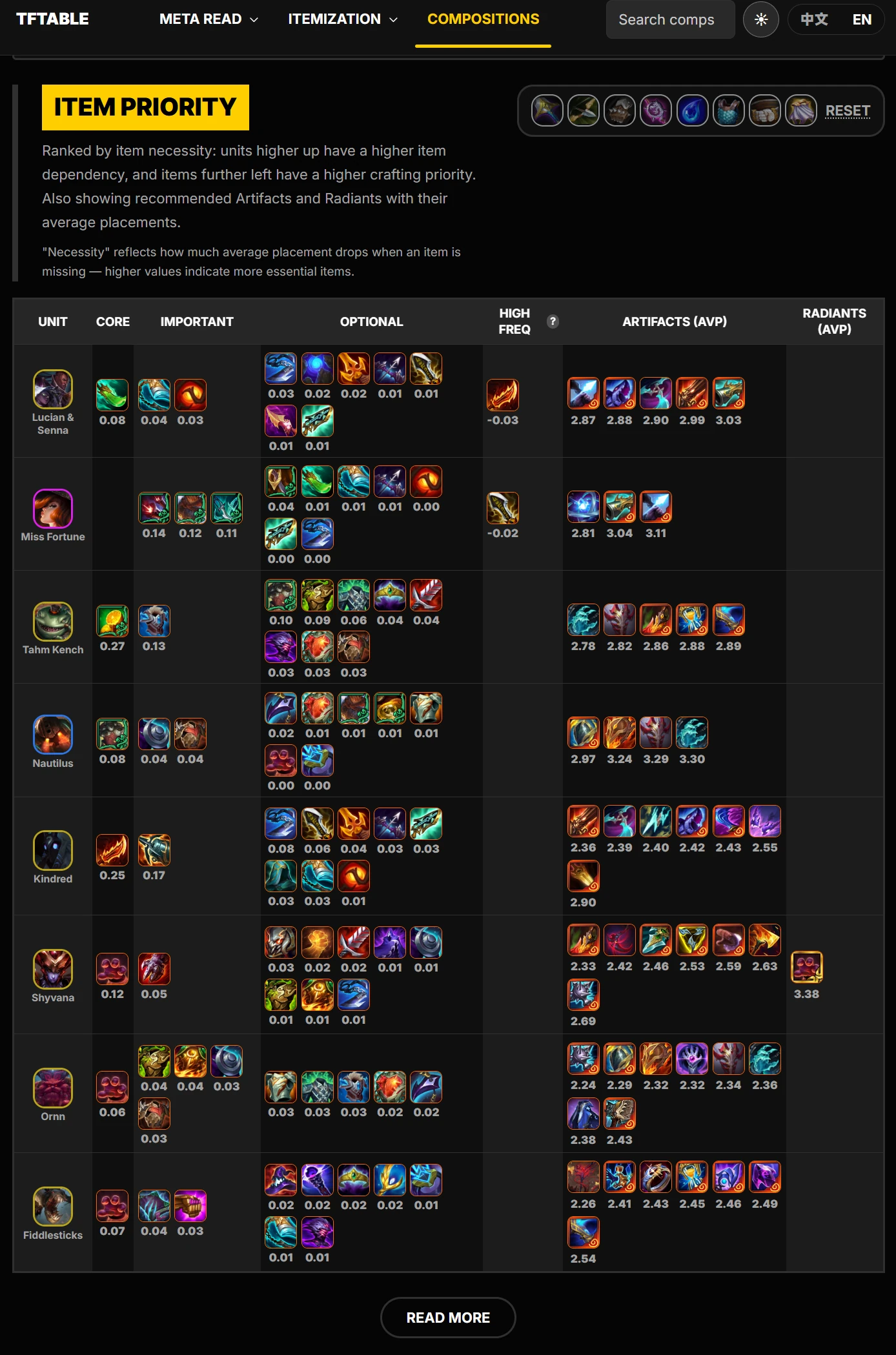
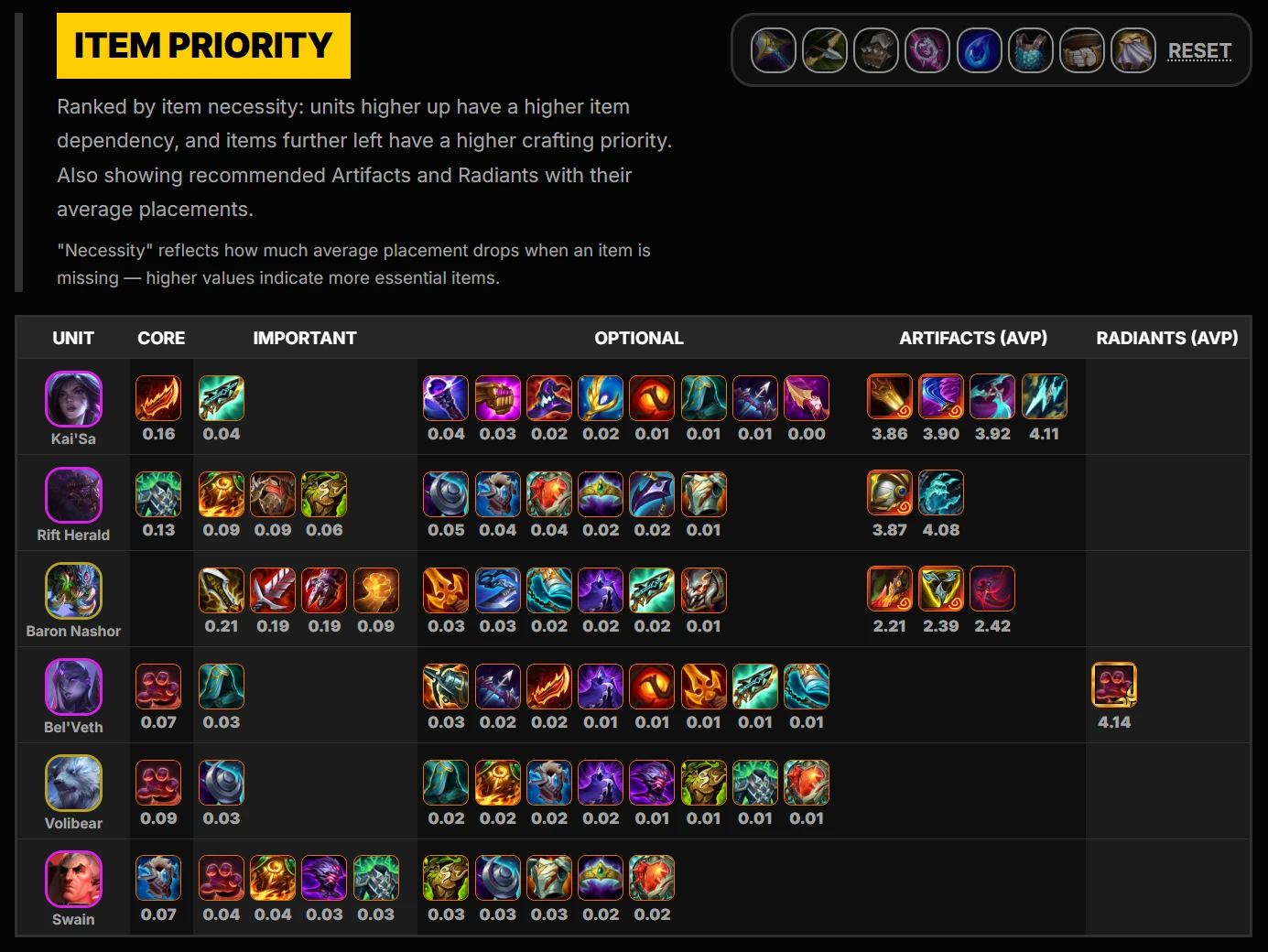
Scrolling further down, you'll see each unit's items ranked by importance tiers, making it easy to tell at a glance which items are core, which are important, and which are optional or high-frequency picks.
Why Necessity Is a Better Metric for Evaluating Items?
It's common for items acquired late in the game (such as from late-stage carousels) to show inflated average placement or delta, even if they have limited real impact on the outcome. Because these items are picked up after a board's strength is largely established, traditional metrics can overestimate their importance.
As a result, item stats on traditional data sites are often hard to interpret at a glance. Players need to do extra work to distinguish between statistical noise caused by timing and items that are truly core to a unit's performance.
To address this, we introduce the Necessity metric.
Necessity measures how much a unit's average placement drops when a specific item is missing.
If a unit performs nearly the same with or without an item, its necessity will be close to zero. If an item is genuinely important, removing it causes a noticeable drop in performance, resulting in a positive necessity value (typically above 0.1).
An Example: Necessity vs. Delta
To illustrate the difference between Necessity and traditional placement delta, consider the following example.
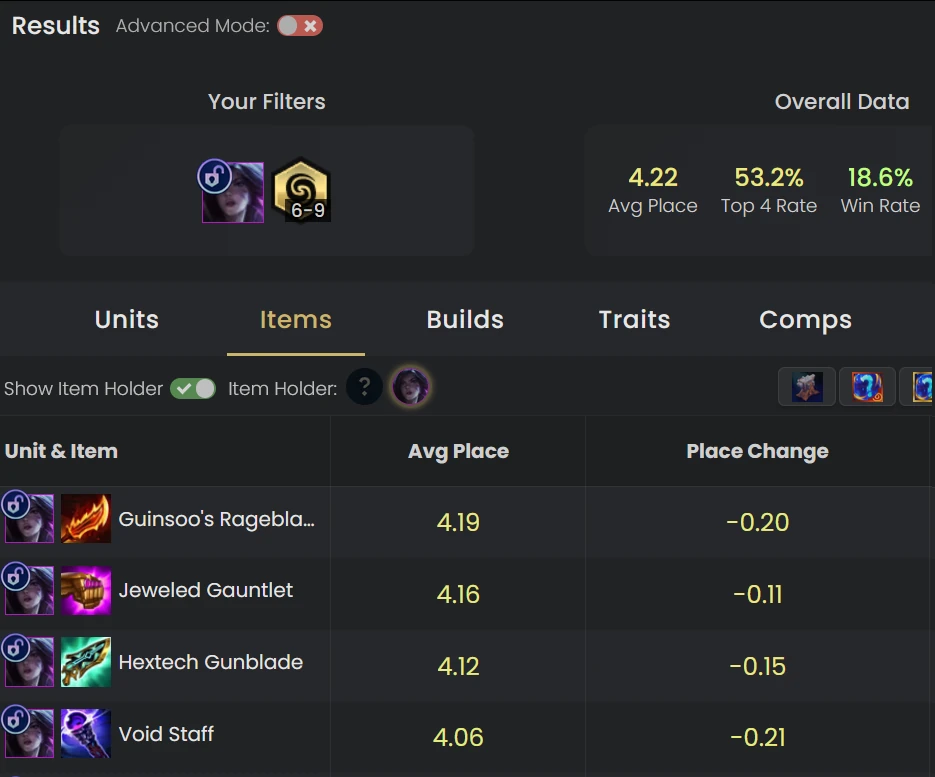
As shown in the chart, 6 Void Kai'Sa with Guinsoo's Rageblade has an average placement of 4.19, while excluding Rageblade results in an average placement of 4.39.
Using the delta, we calculate:
4.19 − 4.39 = −0.20
This gives Rageblade a placement delta of −0.20.
Necessity, however, is calculated differently. It measures the performance drop relative to a unit's expected baseline when a key item is missing. In this case, the calculation is:
4.39 − 4.22 = 0.17
This results in a Necessity value of 0.17 for Rageblade.
If we rank the four items shown in the chart by placement delta, the order is:
Void staff (−0.21) > Rageblade (−0.20) > Hextech Gunblade (−0.15) > Jeweled Gauntlet (−0.11)
However, ranking the same items by Necessity produces a very different picture:
Rageblade (0.14) > Jeweled Gauntlet (0.05) = Hextech Gunblade (0.05) = Void Staff (0.05)
Based on actual gameplay experience, which conclusion feels more believable: that Kai'Sa truly needs Guinsoo's Rageblade, with the other two items being flexible, or that Void Staff is somehow better than Rageblade just because of placement delta?
Another Example: Supporting the Reliability of Necessity
Here is another example that further supports the reliability of the Necessity metric.
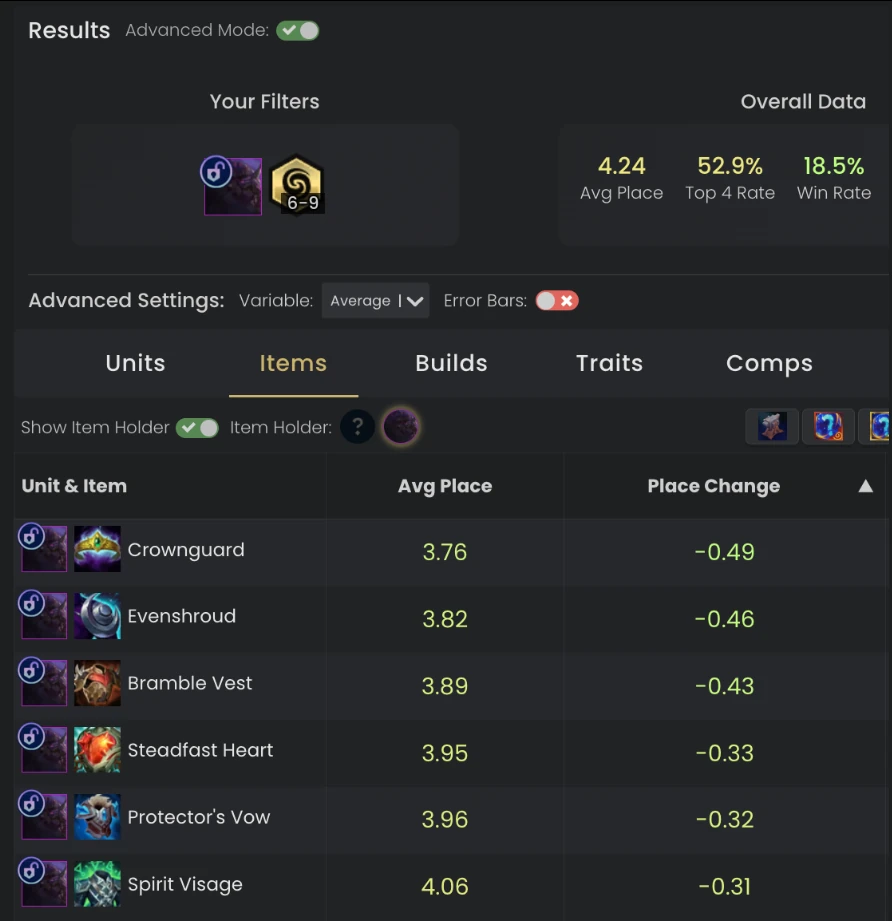
As shown in the chart, this is the placement delta ranking of items built on 6+ Void Rift Herald. From the placement delta alone, Crownguard appears to have the best performance. However, whether Crownguard is truly the best item for Rift Herald requires more analysis.
From a gameplay perspective, Rift Herald gains limited value from Ability Power, gaining only limited damage and minimal damage reduction from AP. In addition, the shield granted by Crownguard at the start of combat does not benefit from the bonus maximum health Rift Herald gains after casting, resulting in weak synergy between the item and Rift Herald's core mechanic. Moreover, in this comp, Needlessly rod are typically prioritized for Kai'Sa's damage items, which might be the best component for Kai'sa, rather than being used to build Crownguard on Rift Herald. For these reasons, Crownguard is rarely an item that players would intentionally build on Rift Herald during actual gameplay.
When we calculate Necessity, the result reflects this reality.
The Necessity value for Crownguard on Rift Herald is:
3.76 − (−0.49) − 4.24 = 0.01
This value is very close to zero, indicating that removing Crownguard from Rift Herald has almost no impact on the unit's average placement. Based on this result, Crownguard can be considered a non-corel item for Rift Herald, consistent with in-game experience.
The BIS (best-in-slot) items for Rift Herald identified by our Necessity metric — Spirit Visage, Sunfire Cape, Bramble Vest, and Warmog's Armor — are all strongly supported by in-game mechanics and practical gameplay understanding.
When Rift Herald casts its ability, it gains a fixed amount of bonus maximum health. This directly synergizes with Warmog's Armor through percentage-based health scaling, and also interacts favorably with Spirit Visage's increased healing effectiveness.
In addition, Void comp generally lack a strong natural holder for Red Buff or Morellonomicon, making Sunfire Cape on a frontline unit the most reliable solution for applying anti-healing.
Finally, the current patch features multiple AD-focused endgame boards (such as Yunara, Kindred, and Baron), which Bramble Vest counters effectively. Its value is further reinforced by top-tier augments like Thorn-Plated Armor, providing a small but consistent performance uplift.
We Collect the Data — You Evaluate
At its core, our site uses custom-defined filters and algorithms to collect large volumes of match data from Riot's API, and derive conclusions from them.
For the current patch, we manually defined 37 distinct comps using specific filtering conditions. On each comp's detail page, you can find the exact filtering logic listed directly beneath the comp name. These conditions are fully transparent and can be replicated on other data sites using the same criteria.
(As a small, passion-driven fan project, our API rate limits are sometimes slower than those of larger platforms, which may result in minor data discrepancies — but nothing that meaningfully affects the overall conclusions.)
Our goal is for every query condition to closely reflect how the game is actually played.
For example, for standard 4-cost Ionia comps, our filters include Wukong and Yunara, prioritize Yunara as the primary carry, assume a 7-Ionia midgame, and allow for a late-game transition into 5 Ionia with strong legendaries units — while explicitly excluding Yasuo reroll and Twilight Trial variants. This is designed to capture real, standard Ionia gameplay.
We also aim to keep query conditions fair across comps of the same cost tier. For instance, if Ionia shows the best average placement among 4-cost carry comps, we want that result to reflect genuine consistency — not bias introduced by more favorable filters.
Similarly, the algorithms used for comp strength, item holders, and item-priority are provisional models based on our current gameplay understanding and experience.
If you have any feedback, disagreements, or suggestions regarding our algorithm logic, comp data evaluations, or item recommendations, we genuinely welcome all possibilities.
You can find our team's social media and contact email at the bottom of the site.
I'm Koyui, a competitive Teamfight Tactics player in CN region. In the recent ranked climb on the CN main server, I finished 7th overall and qualified for the Yunyi Cup Qualifiers (TOC12/2026/Spring).
A large part of my motivation for building and maintaining this website comes from wanting to support my own competitive gameplay. Because of that, I hold the conclusions produced by this site to the extremely high standards I would expect in the TFT competitive tournament.
If you find the site helpful for your own TFT games, we warmly welcome any feedback or suggestions — and we hope to keep improving it together with the whole TFT community.